In an attempt to engage with what I am reading, now that I no longer have to submit 'reading reflections' or 'book reviews' for class, and now that I am actually finding that I enjoy reading again, I am going to try interact with what I am reading with this blog.
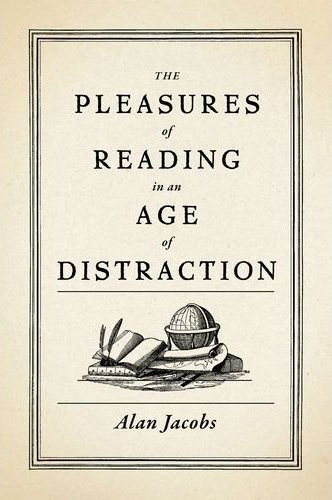
Most recently I finished Alan Jacob's delightful little book, The Pleasures of Reading in an Age of Distraction. Having read his work on C. S. Lewis I took a look at Goodreads to see what else the man had written that might pique my interest. I know, I know - a book on reading. But the title alone was enough to draw me in. I am a sucker for my iPhone, Netflix, the blogosphere and the never ending news cycle, but I have also been finding myself lamenting my own inability to concentrate and interact with a book in a meaningful way now that I am no longer in grad school and I no longer have a prescribed reading last.
Jacob's book did not disappoint as a general pleasure to read. Much of this is from the reality that he doesn't seek to make his reader feel guilty for what they have chosen to read or not read. In fact, the one of the first sections of the book the book is titles, simply, 'Whim', which is best summed up here:
"Read what gives you delight - at least most of the time - and do so without shame." (23)
He notes his agreement with Lewis and Chesterton here, and breaks rank with Harold Bloom about the primacy of Great Books in our reading repertoire, indicating what I think is the most important part of finding pleasure in reading again and saying no to the constant urge to check on what is happening in the news every 2 minutes - delight. Not everyone delights in reading, Jacobs notes this, but for those that do and for whom that delight is not a compulsion that will always trump Facebook, Twitter, The Walking Dead, and the latest theological controversy in the blogosphere, then delight is important. This does not mean that you should only read the 'fun' stuff, but that in reading what gives you delight and allowing yourself to read at whim, you can both read for information and pleasure without begrudging the fact that you have to read at all.
The things that made this book such a delight for me are that Jacobs actually took the time to engage with other authors, didn't deride the e-reader set, and patently refused to make me feel guilty about my reading choices by giving his own preferred list of things I should be reading.
I would recommend this book without hesitation to anyone who loves to read and yet feels that little twinge of guilt about how distracted they have become. Encouragement abounds that we can overcome these distractions and once again enjoy reading the books that we've been wanting to read, and even more so the books that these books lead us to. He spends time noting the quirks of the reader - to underline/annotate or not (most definitely to, but judiciousness is key), the love of the feel of a book in hand (but the guilty pleasure of the eReader for the things maybe we don't have room for in our always too big libraries), the joy we feel in interacting with a book, to read aloud or silently (depends on when/where), and many many more.
Finally, I am appreciative of the fact that he acknowledges the need to look back at what we have read and have our own, very personal, opinions about these. I found his reference to Auden especially helpful,
"The best guide I know to readerly judgment is our old friend Auden, who graciously summed up a lifetime of thinking about these matters in a single, incisive sentence: 'For an adult reader, the possible verdicts are five: I can see this is good and I like it; I can see this is good but I don't like it; I can see this is good, and, though at present I don't like it, I believe with perseverance that I shall come to like it; I can see that this is trash but I like it; I can see this is trash and I don't like it.'" (133)
So this is the rubric I will use when I interact here with the books (and other things) I have read.
My own readerly judgment: I can see this is good and I like it.
